

It’s incredibly common for people around the globe to start building an age prevention skincare routine in their twenties.
Yet when it comes to their hair, most wait until the damage is already done – think visible thinning, excessive shedding, and hairline recession.
“But hair health is a long game. The decisions you make about your scalp, your nutrition and your styling habits in your twenties will influence what your hair looks and behaves like in your forties and beyond,” says Ricardo Vila Nova, trichologist and founder of 212.2 Ricardo Vila Nova. The good news is that the earlier the intervention, the more there is to preserve, and it is never too late to start.

In your 20s: building the foundation
Hair in your twenties is typically at its most resilient. Follicles are active, growth cycles are long and the scalp microbiome (the community of microorganisms that regulates inflammation and barrier function) is usually well balanced. This makes it easy to assume no action is needed. It is also when the habits most likely to compromise long-term hair health are being established.
“The follicle has a memory. Repeated heat exposure, tight styling, nutritional deficiencies, chronic stress, these accumulate over time and create a baseline level of stress on the follicle that compounds with age. The person who protects their hair intelligently in their twenties is investing in density they will still have in their forties,” says Vila Nova. In this decade, the priority is establishing the fundamentals: a diet rich in protein, iron, zinc and B vitamins; styling habits that minimise mechanical tension; and becoming familiar with your hair’s natural density and growth rate so that any future deviation from your personal baseline is noticed early. “This is the perfect decade for your first Hair DNA Scan at 212.2 Ricardo Vila Nova, as at this stage it can map the genetic, hormonal and nutritional factors specific to your hair, enabling a preventative plan built around your individual biology rather than general advice,” says Vila Nova.
In your 30s: reading the early signals
The thirties are when the first subtle signals tend to appear – think, slightly more hair in the shower, a parting that looks fractionally wider, strands that feel a little finer than they once did. “In women, this decade often brings the early stages of hormonal fluctuation – perimenopause can begin as early as the mid-thirties, and thyroid changes, shifts in androgen levels and the aftermath of pregnancy all directly affect the follicle cycle. In men, androgenetic alopecia (driven by follicle sensitivity to DHT) often begins to manifest visibly in this decade, with the hairline or crown the first areas to show change. Alongside these hormonal shifts, the consequences of a decade of suboptimal scalp care, chronic stress or high-tension styling start to emerge. This is a critical window, not for alarm, but for action,” says Vila Nova.
Blood work assessing ferritin, thyroid function, vitamin D and hormone levels is advisable at this stage for anyone noticing changes. And regular scalp detoxification treatments at 212.2 Ricardo Vila Nova to address microbiome imbalance, remove follicle-blocking build-up and reduce the low-grade inflammatory load that shortens the growth phase, are a must too. Add personalised mesotherapy, which is the intradermal delivery of a bespoke blend of vitamins, minerals and peptides directly to the scalp, to further support the follicle environment from within.

In your 40s: navigating hormonal change
For many women, perimenopause arrives in full force in their forties. Fluctuating and declining oestrogen levels reduce the follicle’s natural protection against androgens, accelerating miniaturisation, which is the process by which follicles gradually produce finer, shorter, weaker strands before eventually becoming dormant. The anagen phase shortens, shedding increases and density visibly declines. For men, androgenetic alopecia may have progressed significantly by this decade, resulting in noticeable hair loss that’s hard to ignore.
“This is the decade in which the cumulative effects of biological ageing, hormonal change and lifestyle history converge most forcefully on the hair. But intervention remains highly effective because follicles are still active and responsive. The goal is to slow the rate of change, reduce inflammation aggressively and retain as much density as possible,” explains Vila Nova.
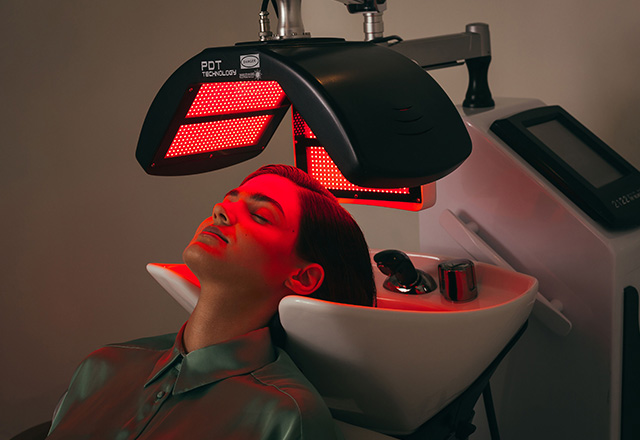
At 212.2 Ricardo Vila Nova, treatment protocols in this decade typically combine scalp detoxification, personalised mesotherapy, low-level laser therapy (which optimises the energy supply to each follicle and supports cellular repair) and, where appropriate, growth factor treatments including PRP and biosomes.
In your 50s: maintaining what remains
Post-menopause, oestrogen levels stabilise at a lower baseline and many women find the rate of hair change slows. But the follicular environment has shifted permanently, and the hair that remains tends to be finer, more fragile and slower growing. For men in their fifties, density loss may be significant and the focus shifts toward preserving what is active and optimising the quality of existing strands. For both, the scalp requires consistent, targeted support rather than the sporadic attention it may have received previously.
“The follicles that remain active are still capable of producing healthy hair when they are supported correctly. Nutrition, scalp health, circulation and inflammation management remain as relevant at 55 as they are at 35 – the approach simply needs to be calibrated to where the hair is now,” says Vila Nova. In-clinic treatments at 212.2 continue to play a meaningful role, with low-level laser therapy, PRP, biosomes and personalised mesotherapy helping to sustain follicle activity and scalp health. The Active Fusions personalised haircare range, formulated around each individual’s Hair DNA Scan results and incorporating peptides, ceramides, hyaluronic acid, probiotics and B-panthenol, ensures at-home care continues to deliver what the scalp and hair specifically need.
In your 60s and beyond: quality over quantity
When it comes to the sixties and beyond, “the emphasis shifts from growth stimulation to quality preservation. Hair grows more slowly, individual strands are finer and the scalp becomes drier and more prone to irritation as sebum production declines. The temptation to pursue more aggressive treatments can do more harm than good at this stage as gentle, consistent, nourishing care is what the scalp actually needs,” shares Vila Nova.
In-clinic, low-level laser therapy remains highly relevant at this stage, optimising the energy supply to each follicle and supporting cellular repair. Personalised mesotherapy continues to nourish the scalp environment and maintain what activity remains, while the Active Fusions personalised haircare range (formulated around each individual’s Hair DNA Scan results) ensures at-home care delivers exactly what the scalp needs between appointments.
Where density loss is more significant, a hair transplant remains a viable option well into this decade and beyond. There is no fixed upper age limit, what matters is donor hair quality, overall health and realistic expectations. The goal at this stage is natural, age-appropriate coverage rather than recreating the density of youth, and for the right candidate, the results can be transformative. Hair Stem Cell Transplantation, where only a part of each donor follicle is removed and placed into areas where has thinned or been lost – so that hair can regenerate in both the recipient and the donor area – is a technique recommended by Ricardo Vila Nova as it’s a less invasive approach with a faster recovery than traditional methods, making it a particularly practical option for those who want meaningful improvement without significant downtime.
The principle that runs through every decade
Hair longevity is not determined by a single treatment or a single habit, it is the accumulated result of consistent, informed lifestyle and haircare choices.
“The most common thing patients say to me is that they wish they had started earlier. Not because it is too late when they arrive to us, but because they can see, in hindsight, the window during which a little attention would have made a significant difference. Future-proofing your hair is not about doing everything. It is about doing the right things, at the right time, for your specific biology,” concludes Vila Nova.
To explore a personalised preventative hair health strategy, book a consultation using the link below.